
When a severe storm brings 80-mile-per-hour winds through Johnson County, the sound of a cracking trunk is something no homeowner wants to hear. If you've just discovered an olathe kansas tree uprooted on your property, your first instinct is likely a mix of fear and confusion. You're probably worried about live power lines, blocked sidewalks, or whether the City of Olathe will fine you for the mess. It's a high-stakes situation where every hour counts for your family's safety and your property's integrity.
We understand that you need clear answers without any marketing fluff. This guide outlines the immediate safety protocols you must follow and clarifies your legal responsibilities under current 2026 city codes. You'll learn how to determine if your homeowner's insurance will cover the damage and how to identify legitimate, licensed professionals. We'll also show you how to bypass "storm chaser" price gouging by using a competitive bidding process. By the end of this article, you'll have a pragmatic roadmap to clear the debris, protect your wallet, and restore your peace of mind.
Key Takeaways
- Prioritize immediate safety by identifying hazards like downed power lines and keeping children away from the root ball after an olathe kansas tree uprooted incident.
- Identify whether the fallen tree sits on city-owned right-of-way or private property to determine who is legally responsible for the removal.
- Understand how insurance differentiates between structural damage and yard debris removal to maximize your claim potential.
- Avoid "storm chaser" price gouging by securing at least three competitive bids from local, licensed contractors.
- Save time and ensure compliance by using a centralized bidding marketplace to connect with vetted tree removal experts in Olathe.
Immediate Safety Steps After a Tree Uproots in Olathe
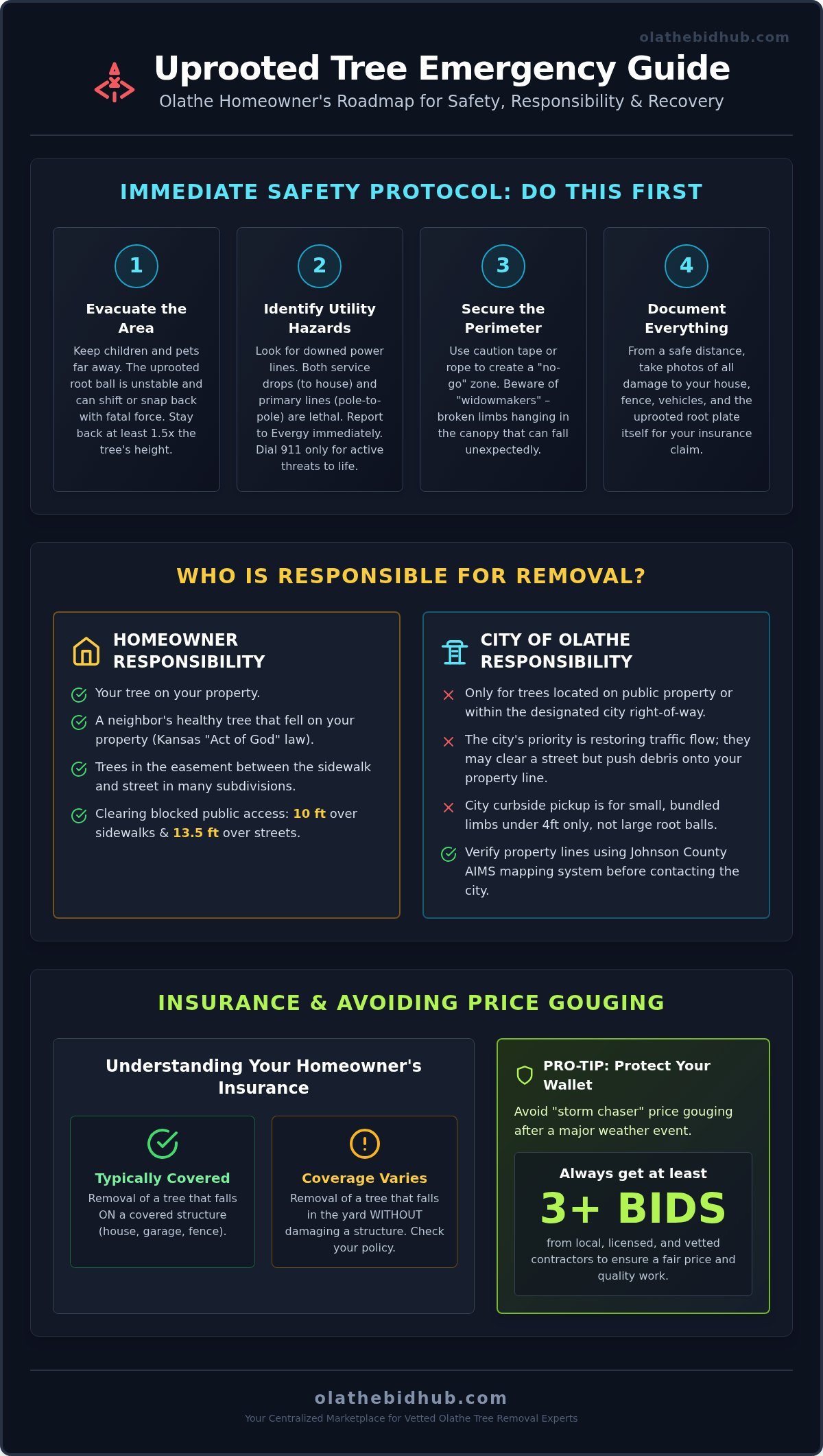
The sudden silence after a Johnson County storm often reveals a chaotic landscape. If you find an olathe kansas tree uprooted on your lawn, your immediate priority isn't the cost of removal or the insurance claim. It's life safety. What you're looking at is what forestry experts call windthrow, a complex event where the tree's entire root system has failed and pulled out of the earth. This creates a highly unstable structure that can shift without warning. Evacuate the area immediately and keep children and pets away from the root ball zone.
When a tree uproots, the weight of the trunk often keeps the root plate under extreme tension. If the trunk is cut or shifts, that root plate can snap back into its hole with enough force to be fatal. Don't let anyone walk near the exposed roots or under the leaning trunk. Stay at a distance that is at least 1.5 times the height of the tree until a professional can assess the stability of the soil and the remaining root structure.
Identifying Utility Hazards (Evergy and Olathe Public Works)
Check for downed lines before you step outside. A "service drop" is the line running from a pole to your house, while primary lines run pole-to-pole. Both are lethal. In Olathe, you must report downed lines to Evergy immediately. Don't assume a neighbor has already called. If the tree is blocking a public street or sidewalk, call the Olathe non-emergency line. Only dial 911 if there's an active fire, a live wire touching a vehicle with people inside, or a direct threat to life.
Securing the Perimeter and Preventing Further Damage
Uprooted trees are significantly more dangerous than those with snapped trunks because their center of gravity is entirely compromised. Use bright rope, caution tape, or even temporary garden fencing to mark a "no-go" zone that extends well beyond the reach of the tallest branches. A widowmaker is a detached or broken limb hanging precariously in the canopy, and it remains the number one cause of injury during post-storm cleanup.
Once the area is secure, document everything. Take photos from a safe distance, capturing the angle of the fall and any damage to fences, roofs, or vehicles. When dealing with an olathe kansas tree uprooted by high winds, your documentation should include the root plate itself to help insurance adjusters understand the cause of failure. Don't attempt to move any branches yourself. Even small limbs can be under enough tension to "spring pole," causing serious injury when cut.
Determining Responsibility: Does the City of Olathe Cover Removal?
Many residents assume the municipal government will handle an olathe kansas tree uprooted by a major storm. This is a common misconception that can lead to expensive delays. Olathe Public Works only manages trees located on public property or within the designated city right-of-way. If the trunk is in your backyard or front lawn, the financial and logistical burden is yours. Even if the city clears a trunk that blocked a public street, they'll often push the debris back onto your property line. Their priority is restoring traffic flow, not cleaning up private landscapes.
Homeowners also face specific maintenance regulations. In Olathe, you're required to trim tree limbs that hang lower than 13.5 feet over a street or 10 feet over a sidewalk. If an uprooted tree is blocking these paths, you must act quickly to clear the hazard. While the city provides curbside pickup for small, bundled limbs under 4 feet long, they won't haul away a massive uprooted root ball. For large-scale debris, residents can use the Olathe Community Recycling Center at 127th and Hedge Lane, but you'll need a way to transport the waste yourself.
Public vs. Private Property Boundaries
Identify your property lines using a legal survey or the Johnson County AIMS mapping system before calling the city. Don't fall into the "easement trap." Just because a tree is located between the sidewalk and the street doesn't automatically make it the city's problem. In many Olathe subdivisions, homeowners are responsible for trees in these transition zones. If you're certain the tree belongs to the city, report it via the OlatheConnect app. For trees on your own land, the fastest way to resolve the issue is to gather competitive bids from local contractors who understand Johnson County's specific disposal requirements.
The Neighbor Dispute: Who Pays for the Cleanup?
Kansas law regarding fallen trees often surprises homeowners. If a neighbor's healthy tree falls into your yard during a high-wind event, it's legally considered an "Act of God." This means you're responsible for the cleanup costs on your property, and your neighbor is responsible for theirs. However, the rules change if the tree was dead or diseased before the storm. An Olathe property owner has a legal duty of care to maintain their trees and remove known hazards. If you can prove the neighbor neglected a dying tree, their insurance might be liable for your damages. Document the tree's condition immediately with clear photos of any rot or decay in the trunk.
Navigating Insurance Claims and Emergency Removal Costs
Understanding the financial side of a storm recovery is just as vital as the physical cleanup. Most standard homeowners policies in Johnson County follow a simple rule: they pay for removal if the tree hits a covered structure. If an olathe kansas tree uprooted and landed on your roof, garage, or fence, your insurance typically covers the cost to lift it off and repair the damage. However, if the tree simply falls onto your lawn without hitting anything, coverage is often limited or non-existent. You'll likely find a "debris removal" cap in your policy, which is a specific dollar limit for hauling away wood that isn't touching a building.
Don't let "storm chasers" complicate your recovery. These out-of-state crews often flood neighborhoods after events like the June 2026 storm that brought 80-mile-per-hour winds to the metro area. They frequently overcharge, which can lead to your insurance company denying part of the claim because the costs don't match local market rates. To protect yourself, always hire a local arborist who provides a detailed, line-itemed invoice. This transparency helps your adjuster verify that the charges are reasonable and necessary for the scope of work performed.
Filing a Claim for Storm Damage in Johnson County
Speed is essential for a successful claim. Notify your insurance agent within the first 24 hours of discovering the damage. Your policy likely includes a clause about "mitigating further damage." This means you're responsible for taking reasonable steps to prevent more problems, such as hiring a pro to tarp a hole in the roof caused by the fallen trunk. Never sign a "Direction to Pay" form without explicit approval from your insurance agent. This document allows the contractor to collect the entire insurance check directly, which can leave you with zero leverage if the work isn't completed to professional standards.
Avoiding Price Gouging During Olathe Storm Emergencies
Predatory services thrive on the chaos following severe weather. Watch for red flags like door-to-door solicitation, high-pressure sales tactics, or contractors who only accept cash. Legitimate local companies will have a physical address and a verifiable "General Liability" policy. Before any equipment starts moving, ask for a certificate of insurance sent directly from their provider to your email. This ensures you aren't liable for any injuries that occur on your property.
Several factors influence the final cost of clearing an olathe kansas tree uprooted by high winds. Large trees requiring crane access or grapple trucks will naturally cost more than those that can be handled with standard chainsaws. If the root ball has pulled up significant amounts of soil or sidewalk, stump extraction becomes a separate, more labor-intensive task. Getting multiple bids is the only way to ensure you're paying a fair price during a high-demand period.
The Professional Uprooted Tree Removal Process
Removing an olathe kansas tree uprooted by a storm is not a standard felling job. It is a precision engineering project that involves managing massive amounts of stored energy. Unlike a standing tree, an uprooted specimen is often under extreme tension and compression at the same time. The trunk may be pinned against your roof or a fence, while the root plate acts like a loaded spring. One wrong cut can cause the trunk to kick sideways or the root ball to flip, creating a lethal situation for anyone nearby.
Professional crews in Johnson County use specialized equipment to manage these risks. Grapple trucks and cranes allow arborists to lift the tree in sections, neutralizing the weight before it shifts. This approach is especially important in established Olathe neighborhoods where tight spaces make traditional felling impossible. By lifting the tree vertically, pros avoid dragging heavy logs across your lawn or driveway, which prevents unnecessary property damage. You can find local experts who own this specific equipment by requesting competitive bids through Olathe Bid Hub.
Why Uprooted Trees Require Specialized Rigging
The "springback" effect is the primary reason you should never attempt this yourself. As the weight of the trunk is removed, the root plate can violently snap back into its original hole, crushing anything or anyone in its path. Crews use heavy-duty rigging and stabilizing cables to lock the root ball in place during the cutting process. A licensed arborist is required for uprooted removals because they possess the technical training to calculate these weight shifts and prevent catastrophic equipment failure. To protect your infrastructure, they often use ground protection mats to distribute the weight of cranes, ensuring your driveway doesn't crack under the pressure.
Post-Removal: Cleanup and Yard Restoration
Once the wood is cleared, you are left with a massive void in your landscape. You must choose between stump grinding, which turns the stump into mulch, or full root extraction, which removes the entire root plate. Full extraction is often necessary if the uprooting has damaged your sidewalk or underground pipes. After the roots are gone, backfilling the hole with high-quality topsoil is critical. If you simply push the old dirt back in, you risk creating a sinkhole as the remaining organic matter decays over time.
Olathe’s heavy clay soil presents unique challenges for restoration. This soil compacts easily under the weight of storm debris and removal equipment, which can suffocate the roots of your remaining plants. If you plan to plant a replacement tree, you'll need to till the area and incorporate organic amendments to improve drainage. While you can haul smaller debris to the Olathe Community Recycling Center, a professional service will typically include full site restoration and debris haul-away in their bid, saving you hours of manual labor.
Getting Competitive Bids for Emergency Tree Removal in Olathe
When dealing with an olathe kansas tree uprooted by a storm, the stress of the situation often leads to hasty financial decisions. Don't hire the first contractor who knocks on your door. Obtaining at least three separate bids is the industry standard for ensuring you receive a fair market rate. Prices for emergency removal can fluctuate wildly depending on a company’s current workload and available equipment. By forcing companies to compete for your project, you naturally drive down the "emergency premium" that many services charge during peak storm seasons.
Olathe Bid Hub acts as a knowledgeable bridge between you and the local tree care community. Instead of spending hours on the phone repeating your story to twenty different secretaries, you can manage the entire process from a single platform. This marketplace is specifically designed for Johnson County residents who need professional results without the administrative headache. It facilitates a transparent environment where quality and price are clearly visible before you sign any contracts.
How Olathe Bid Hub Streamlines Your Crisis
Efficiency is the core of our platform. You simply upload photos of the uprooted tree and provide basic details about the site access. This information is immediately shared with a network of vetted, licensed contractors within a 30-mile radius of Olathe. You'll receive multiple bids in your dashboard, allowing you to compare insurance certificates and licensing status side-by-side. This no-obligation process keeps contractors honest and ensures you aren't being exploited during a property crisis. It's the fastest way to verify that a pro is part of the Olathe licensed network without doing the legwork yourself.
Choosing the Right Bid, Not Just the Lowest
The cheapest bid isn't always the safest or most effective choice. Evaluate each proposal based on the specific equipment they plan to use, such as the grapple trucks or cranes required for high-tension removals. Ensure the bid explicitly includes debris haul-away and site cleanup. Local Olathe contractors are almost always a better choice than out-of-state storm crews because they understand city disposal regulations and have a reputation to maintain within the community. Before you approve any bid, use this final checklist:
- Verify the contractor's active General Liability insurance certificate.
- Confirm the estimated start and completion dates in writing.
- Check if stump grinding or full root extraction is included in the total.
- Ensure the contractor has a valid Olathe business license.
- Confirm that no large upfront deposits are required before equipment arrives.
By following this methodical approach, you turn a chaotic property emergency into a managed project. You'll save money, protect your insurance claim, and ensure the job is done by a professional who respects your property and the local Olathe community.
Restore Your Property Safely and Affordably
Managing an olathe kansas tree uprooted by a storm requires a balance of immediate safety and strategic financial decisions. You now know how to identify utility hazards, determine if the city shares the removal burden, and navigate the complexities of insurance claims. By prioritizing licensed arborists over transient storm crews, you protect your property from further damage and ensure your insurance documentation remains airtight. This methodical approach prevents a single storm event from becoming a long-term financial headache.
Take the next step by letting the experts come to you. You can get competitive bids for your uprooted tree removal on Olathe Bid Hub for free. Our platform connects Olathe property owners with vetted, local contractors who bid against each other to earn your business. This competitive environment ensures you pay a fair local rate rather than an inflated emergency fee. Don't let a fallen tree stall your recovery; secure your professional cleanup today and get your landscape back to normal with confidence.
Frequently Asked Questions
Does the City of Olathe pick up trees that fall in the street?
The City of Olathe Public Works department clears trees only when they obstruct public streets or sidewalks. If a tree falls from your yard into the road, crews will typically move the logs onto the edge of your property to restore traffic flow. You remain responsible for the final disposal of the wood and the root ball. Check the OlatheConnect app to report blockages on city-maintained infrastructure.
How much does it cost to remove an uprooted tree in Olathe?
Market rates for tree removal in Olathe vary based on the tree's size and the difficulty of the extraction. While smaller jobs might start around $400, complex removals involving cranes or large root systems can exceed $2,500. These figures represent general local averages for professional services and don't include stump grinding. Getting multiple bids is the only way to confirm a specific price for an olathe kansas tree uprooted on your land.
Will my insurance pay for a tree that fell in my yard but didn't hit anything?
Standard homeowners insurance rarely pays for tree removal unless the trunk damages a covered structure like your house or garage. If an olathe kansas tree uprooted and landed in an open area of your lawn, the cleanup is usually an out-of-pocket expense. Some policies offer a small debris removal benefit if the tree blocks a driveway or a handicap ramp; you should verify these specific limits with your local agent.
Who is responsible if my neighbor's tree falls on my fence in Olathe?
You are generally responsible for the cleanup costs if a neighbor's tree falls onto your property during a storm. Kansas law views these incidents as Acts of God rather than the neighbor's fault. The only exception is if you can prove the tree was dead or diseased and the neighbor ignored previous warnings. In that case, their insurance may be liable for the damage to your fence or home.
What is the "springback" danger with uprooted trees?
Springback occurs when the weight of the trunk is removed from an uprooted tree, causing the root ball to snap back into its original hole. This movement is sudden and carries enough force to be fatal. Professional crews use stabilizing cables and heavy machinery to pin the root plate during the cutting process. Never stand in the hinge area or the hole itself while a contractor is bucking the logs.
How do I check if an Olathe tree service is actually insured?
Always ask for a Certificate of Insurance (COI) that comes directly from the contractor's insurance agent. A legitimate Olathe tree service won't hesitate to provide this document. Verify that the policy includes both General Liability and Workers' Compensation coverage. This protects you from being held liable if a worker is injured on your property or if a crane accidentally damages your neighbor's roof during the removal.
Can I leave an uprooted root ball in my yard?
Leaving an uprooted root ball is not recommended and may violate city property maintenance codes. The City of Olathe requires homeowners to remove dead or severely damaged trees that pose a hazard. Beyond legal issues, an open root pit creates a significant safety risk for children and pets. Over time, the decaying organic matter will cause the ground to settle, leading to a permanent sinkhole in your landscape.
Does Olathe Bid Hub charge homeowners for tree removal quotes?
Olathe Bid Hub is completely free for property owners to use. We provide a platform where you can post your project details and receive competitive bids from a network of vetted local contractors. You aren't obligated to hire any of the professionals who submit a quote. Our goal is to simplify the connection between homeowners and insured tree services, ensuring you find a fair price without making dozens of phone calls.
